


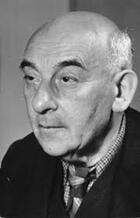


Victor Klemperer, the ninth and last child of Rabbi Wilhelm Klemperer, was born in 1881 in Landsberg an der Warthe (now Poland) and moved to Berlin in 1891. After completing his secondary education, which he interrupted for three years to work as a shop apprentice, he studied Romance and Germanic philology between 1902 and 1905. He again interrupted his studies, married the pianist Eva Schlemmer, and lived precariously on his earnings as a journalist. In 1912, after converting to Protestantism, he moved to Munich, where he resumed his studies and earned his doctorate in Germanic philology in 1913. However, his encounter with the Romance philologist Karl Vossler definitively steered his studies toward Romance philology, and in 1914 he presented his habilitation thesis in Munich.
During the First World War, he enlisted as a volunteer, fought on the front lines for several months, and later worked in the German military administration. From 1920 he was a professor of Romance philology at the Dresden University of Technology, from which he was expelled in 1935 because of his Jewish heritage. Unable to continue his research due to lack of access to libraries, he began writing his curriculum vitae, which was published posthumously in 1989. Victor Klemperer was forced to live in "houses for Jews" and work as a factory laborer. His diary-writing, a practice he had maintained since his youth, intensified to the point of becoming a moral imperative. After the war, Victor Klemperer returned to his professorship in Dresden. In 1945 he joined the Communist Party of Germany. Two years later he published Lingua tertii imperii, still considered the best study on the language of the Third Reich. Between 1947 and 1960, he taught at the universities of Greifswald, Halle, and Berlin, and in 1950, he became the deputy responsible for cultural affairs in the Volkskammer, the parliament of East Germany. In 1952, a year after Eva Schlemmer's death, he married the Germanist Hadwig Kirchner. That same year, he received the National Prize for Arts and Literature. He died on February 11, 1960. In 2022, Galaxia Gutenberg published *I Want to Bear Witness to the End*, a collection of his most significant writings, which focus particularly on describing daily life under a dictatorship. In 2024, he published the essay *Light and Shadows*.